At the end of the novel, I am yet to make a clear distinction of who the antagonist would be. There is Ariah, who grows to become a bitter widow, unwilling to speak about the family's past. Her constant feeling of being "damned" throughout the novel could have possibly brought evil into the Burnaby family.
But then again, there is Dirk, the root of all the problems for the Burnaby family: secrecy, death, shame. Even though Dirk dies 3/4 through the novel, his presence still lingers on his children, making them go through terrible experiences to find the truth.
Maybe, the antagonist is the Woman in Black, temptation herself. Her enticement captured Dirk and Royall Burnaby, causing the root problems of Dirk's stressful life and Royall's adulterous sin. The large idea of temptation, present in all of the Burnaby's lives, possibly led to their ruin; they are unable to resist finding out the secrets. And these secrets - they cause the Burnabys to do whatever they can to find out the truth; Dirk even dies after he attempts to find out! (Love Canal trials)
But mainly, if I had to guess, I would think that the Falls themselves were the deep root of the problems, the antagonist of the novel. The Falls had some kind of power over those who wear near to it, especially the Burnabys. Even in the beginning of the novel, it was the cause of death for Gilbert Erskine. It sought after sacrifice and truth no matter what the means were to get it. Although the Falls were not personified, its ominous presence in the lives and thought processes of the Burnabys that someone would be blind not to see its control and antagonism over the family.
"Once on Goat Island, Ariah made her way to Terrapin Point by the eastern loop of the path, which was the one the suicide had taken. There she stood unmoving for as long as a half-hour, a lone, melancholy figure in her incongruously gaily colored slicker, under the spell of the thunderous Horseshoe Falls. As the morning lightened, the eerie glassy-green aura of The Falls became more distinct. Faint rainbows appeared, shimmering in the mist. The roaring of the cataract at Terrapin Point was so loud it entered your very being, casting out coherent thoughts. You could not recall your name in such a din, and you would not wish to recall it. You felt yourself a heartbeat away from the primal core of being: sheer energy, nameless, and inviolate." (76)
"The voices! The voices in The Falls ... In winter The Falls are encased in ice and rainbows of ice glitter across the Gorge and mist is frozen like spun glass covering the trees and there is a frail ice bridge that forms across the river between Luna Island and Bridal Veil Falls and you want to believe you can cross that bridge and the voices are muted, almost inaudible, you have to hold your breath to hear. But with the thaw in late March, early April, the voices return, louder, harsher, yet seductive..." (411)
It is clear that The Falls posses an eerie, supernatural power over the Burnabys. The constant darkness that falls over The Falls is no coincidence. It has an ominous presence about it, invading the Burnabys' lives and constantly taunting them with an empty feeling of secrecy and death. In addition, The Falls seem to be the fate of the Burnabys, literally and figuratively. For Dirk Burnaby, The Falls is his final resting place, where he, like Gilbert Erskine, disappeared into "oblivion". However, for the rest of the Burnaby family, The Falls could represent the fall from love, success, and truthfulness, ultimately causing the wrecking of their family.
Throughout the novel, Oates leaves a hovering sense of The Falls on every page, not allowing the Burnaby family and the reader escape from it.
Friday, December 11, 2009

Thursday, December 10, 2009
Symbolism
Reginald Burnaby The Great
"His notorious ancestor Reginald Burnaby the Great had walked an eight-hundred-foot wire strung across the American Falls on Independence Day 1869... He was a lean, swarthily handsome gypsy-looking individual of about twenty-eight... his daring exploit was celebrated in the newspapers as far away as San Francisco, London, Paris, and Rome... This crossing was sponsored by the daredevil himself, allegedly in need of money to support his wife and newborn baby... Burnaby painted his face in the 'warpaint' of an Iroquois Indian brave... To the horror of the crowd, Burnaby plunged nearly two hundred feet into the churning water at the foot of the Falls ... a powerful undertow sucked him down into the swift, green-tinged water... The broken battered body of Reginald Burnaby, scarcely recognizable except for the boldly painted head and face, wasn't discovered for several days... tightrope walking across the Niagra Gorge was officially banned." (67-69)
"In a framed photograph in Dirk's study there was a faded daguerreotype of his notorious grandfather Reginald Burnaby, a tightrope walker captured in the act of crossing the steamy Niagra Gorge, holding a twelve-foot pole across his shoulders for balance. Ariah understood that precariousness of that balance." (169)
The importance of Reginald Burnaby has many meaning throughout The Falls. First, his most gruesome death in front of thousands sheds light on the violent power that the Falls have over everyone, no matter how special you may seem. When compared to his grandson, Dirk Burnaby, Reginald and him are very much alike. First, they both do risky things which ultimately lead to their ruin and death, sacrificing their comfort and safety for those they care about. In Dirk's case, he commits to the Love Canal trials, where he cared for the family he was representing; his loss in court led to the fall of his law practice and the "accident" that was this death. Similarly, Reginald's and Dirk's deaths were at the hands of the Niagra Falls, a most deathly and majestic place.
On a broader and more general level, the character of Reginald Burnaby could be a reflection of the struggles one goes through in life. His struggle, which was to balance over a treacherous fall, reflects the struggles that everyone must endure to achieve success. These struggles, however, are unsteady, teetering on a tightrope walk. Oates makes the statement that struggles exist in life, and sometimes, you may fail. These struggles are not easy. Life is not easy; it is a balancing act - the most unsteadiest experience of all.
The Woman in Black
"A vulture the woman seemed to him. Hovering at the edge of his vision. Perched, hunched, staring unblinking at him. Waiting. She was the Woman in Black. She was observing him, she was waiting to waylay him. She was patient, relentless. Waiting for him. Waiting for Dirk Burnaby to weaken. She had his name, and she had his number. He dreaded her coming to his home in Luna Park." (186)
"He stood mute, rooted to the spot, like a hapless character in a children's cartoon. And the woman, at such close quarters, gazed at him so warmly. Her eyes were shadowed and faintly bloodshot yet they seemed to him luminous eyes, darkly bright, with a tawny hazel glow, and beautiful. Her skin appeared translucent, stretched tight across the delicate bones of her face; at her temples, there were faint blue veins. The woman's face was lightly powdered, her lips were dark crimson and fleshy and beautiful to him. At its neckline, the shimmery black sheath was loose, and Royall could see the woman's pallid, ghostly skin inside, the tops of her bare breasts. Royall felt an overwhelming sensation of warmth, tenderness. His eyes flooded with moisture, he was so suddenly happy." (288)
The Woman in Black, seen from the beginning as an omnipresence in Dirk Burnaby's life, can be considered as a dark figure in human nature. Literally, the woman is dressed in black, already having a dark aura about her, containing some kind of dark power over the Burnaby men. To Dirk, the woman is constantly in his mind, as if she is an actual part of him, trying to weaken him with every passing minute. In fact, Dirk is drawn to the woman; she has a power over him. To Royall, she is the same woman, but as a mistress, causing him to feel warm emotions brought on by, in his mind, sinful thoughts.
Oates uses The Woman in Black to symbolize the universal theme of temptation. In both cases, the woman is a threatening figure (enemy of Niagra and mistress) to those who are around her, especially Dirk and Royall. This temptation ultimately leads to Dirk's death and Royall's cheating. Oates makes a clear argument in stating that temptation is sin, dressed in black. Watching over all the time, the Woman in Black is described as a beautiful figure with a ghostly presence, as if she is deceiving all those who come near. Her omnipresence in the lives of the Burnaby men show that temptation is never-ending, and in Oates' eyes, the source of all ruin. Resist temptation to survive.
"His notorious ancestor Reginald Burnaby the Great had walked an eight-hundred-foot wire strung across the American Falls on Independence Day 1869... He was a lean, swarthily handsome gypsy-looking individual of about twenty-eight... his daring exploit was celebrated in the newspapers as far away as San Francisco, London, Paris, and Rome... This crossing was sponsored by the daredevil himself, allegedly in need of money to support his wife and newborn baby... Burnaby painted his face in the 'warpaint' of an Iroquois Indian brave... To the horror of the crowd, Burnaby plunged nearly two hundred feet into the churning water at the foot of the Falls ... a powerful undertow sucked him down into the swift, green-tinged water... The broken battered body of Reginald Burnaby, scarcely recognizable except for the boldly painted head and face, wasn't discovered for several days... tightrope walking across the Niagra Gorge was officially banned." (67-69)
"In a framed photograph in Dirk's study there was a faded daguerreotype of his notorious grandfather Reginald Burnaby, a tightrope walker captured in the act of crossing the steamy Niagra Gorge, holding a twelve-foot pole across his shoulders for balance. Ariah understood that precariousness of that balance." (169)
The importance of Reginald Burnaby has many meaning throughout The Falls. First, his most gruesome death in front of thousands sheds light on the violent power that the Falls have over everyone, no matter how special you may seem. When compared to his grandson, Dirk Burnaby, Reginald and him are very much alike. First, they both do risky things which ultimately lead to their ruin and death, sacrificing their comfort and safety for those they care about. In Dirk's case, he commits to the Love Canal trials, where he cared for the family he was representing; his loss in court led to the fall of his law practice and the "accident" that was this death. Similarly, Reginald's and Dirk's deaths were at the hands of the Niagra Falls, a most deathly and majestic place.
On a broader and more general level, the character of Reginald Burnaby could be a reflection of the struggles one goes through in life. His struggle, which was to balance over a treacherous fall, reflects the struggles that everyone must endure to achieve success. These struggles, however, are unsteady, teetering on a tightrope walk. Oates makes the statement that struggles exist in life, and sometimes, you may fail. These struggles are not easy. Life is not easy; it is a balancing act - the most unsteadiest experience of all.
The Woman in Black
"A vulture the woman seemed to him. Hovering at the edge of his vision. Perched, hunched, staring unblinking at him. Waiting. She was the Woman in Black. She was observing him, she was waiting to waylay him. She was patient, relentless. Waiting for him. Waiting for Dirk Burnaby to weaken. She had his name, and she had his number. He dreaded her coming to his home in Luna Park." (186)
"He stood mute, rooted to the spot, like a hapless character in a children's cartoon. And the woman, at such close quarters, gazed at him so warmly. Her eyes were shadowed and faintly bloodshot yet they seemed to him luminous eyes, darkly bright, with a tawny hazel glow, and beautiful. Her skin appeared translucent, stretched tight across the delicate bones of her face; at her temples, there were faint blue veins. The woman's face was lightly powdered, her lips were dark crimson and fleshy and beautiful to him. At its neckline, the shimmery black sheath was loose, and Royall could see the woman's pallid, ghostly skin inside, the tops of her bare breasts. Royall felt an overwhelming sensation of warmth, tenderness. His eyes flooded with moisture, he was so suddenly happy." (288)
The Woman in Black, seen from the beginning as an omnipresence in Dirk Burnaby's life, can be considered as a dark figure in human nature. Literally, the woman is dressed in black, already having a dark aura about her, containing some kind of dark power over the Burnaby men. To Dirk, the woman is constantly in his mind, as if she is an actual part of him, trying to weaken him with every passing minute. In fact, Dirk is drawn to the woman; she has a power over him. To Royall, she is the same woman, but as a mistress, causing him to feel warm emotions brought on by, in his mind, sinful thoughts.
Oates uses The Woman in Black to symbolize the universal theme of temptation. In both cases, the woman is a threatening figure (enemy of Niagra and mistress) to those who are around her, especially Dirk and Royall. This temptation ultimately leads to Dirk's death and Royall's cheating. Oates makes a clear argument in stating that temptation is sin, dressed in black. Watching over all the time, the Woman in Black is described as a beautiful figure with a ghostly presence, as if she is deceiving all those who come near. Her omnipresence in the lives of the Burnaby men show that temptation is never-ending, and in Oates' eyes, the source of all ruin. Resist temptation to survive.
Tuesday, December 8, 2009
The American Themes
The Destruction of a Family
Throughout The Falls, the characterization and social interaction of the Burnaby family is being examined under a microscope. How each person copes with the unraveling secrets of the Burnaby's past is the main purpose of the novel. Oates examines human nature when a person's world falls apart.
The Burnaby family had originated in the most peculiar way; love at first sight. Immediately, Ariah and Dirk were married, and a baby was on the way. The extreme quickness of their development with each other provided immediate unsteadiness in their lives, creating tension, secrecy, and boundaries between them. Once Chandler was born, Ariah became selfish and greedy for a better life, a better child. However, even their second child Royall couldn't quench her thirst for more; she needed a daughter, so she had Juliet. Although their lives seemed perfect from the outside - fame, wealth, love - both Ariah and Dirk were falling into either damnation or the underworld. The final straw between their marriage was Dirk's acceptance of taking on the Love Canal trials, ultimately, upsetting his wife and losing his own life to The Falls.
Trying to unravel the secrets of their father's death and their family's mysterious past (including Ariah as the Widow-Bride), the children became aggressive with each other and consumed by the mystery, leading to their own ruin. With the ultimate destruction of their family, the Burnabys had a, "curse on [their] name. [Their] name is a curse." (411)
The Force of Nature
From the beginning of the novel, it is made clear to the reader of the Falls power and ability to destroy and enchant in the most awful ways. Throughout the novel, Oates makes references to the Falls and its ability to control, causing someone to lose themselves to its omnipresent dominance. The Fall's spell over the Burnaby family, especially Ariah and Dirk, changes them from a loving family to a torn one, possessed by the secrets of their pasts; it fuels their desires to discover.
At the end of the novel, during Dirk's memorial, the Falls is characterized as not something dark, but rather as something filled with light. Although I do not believe that this light is some kind of pureness or good, I do think that it represents the final truth that the Burnaby children discover about their father. The importance of the disappearance and reappearance of light over the falls reflects the torn family and the pain that it went through to find the truth.
"It's a fact: elsewhere in Niagra Falls the air of September 21, 1978 is muggy, hardly breathable; of texture of rotted fabric filtered through a corrosive mustardy sun. But here in Prospect Park, close by the Niagra Gorge, the air is fresh as of charged with electricity. You want to love: you want to love forever... Airborne particles of moisture, blown from The Falls, quiver with light. From time to time during the ninety-minute memorial for Dirk Burnaby 1917-1962 as the sun disappears and reappears between strips of tattered clouds, rainbows become visible above the Gorge. So faint, so frail, hardly more than optical illusion they seem. Look a second time, they're gone." (481)
The Use of American History
In The Falls, Oates centers the story around the Love Canal trials. Providing a short history of the Love Canal history, Oates changes the names of the main people in the trials. The basic facts are true though in that the case was never resolved until 1978 (It started in 1962), and Burnaby did not live to see the outcome. Because Burnaby took this case, his life went to ruins.
Throughout The Falls, the characterization and social interaction of the Burnaby family is being examined under a microscope. How each person copes with the unraveling secrets of the Burnaby's past is the main purpose of the novel. Oates examines human nature when a person's world falls apart.
The Burnaby family had originated in the most peculiar way; love at first sight. Immediately, Ariah and Dirk were married, and a baby was on the way. The extreme quickness of their development with each other provided immediate unsteadiness in their lives, creating tension, secrecy, and boundaries between them. Once Chandler was born, Ariah became selfish and greedy for a better life, a better child. However, even their second child Royall couldn't quench her thirst for more; she needed a daughter, so she had Juliet. Although their lives seemed perfect from the outside - fame, wealth, love - both Ariah and Dirk were falling into either damnation or the underworld. The final straw between their marriage was Dirk's acceptance of taking on the Love Canal trials, ultimately, upsetting his wife and losing his own life to The Falls.
Trying to unravel the secrets of their father's death and their family's mysterious past (including Ariah as the Widow-Bride), the children became aggressive with each other and consumed by the mystery, leading to their own ruin. With the ultimate destruction of their family, the Burnabys had a, "curse on [their] name. [Their] name is a curse." (411)
The Force of Nature
From the beginning of the novel, it is made clear to the reader of the Falls power and ability to destroy and enchant in the most awful ways. Throughout the novel, Oates makes references to the Falls and its ability to control, causing someone to lose themselves to its omnipresent dominance. The Fall's spell over the Burnaby family, especially Ariah and Dirk, changes them from a loving family to a torn one, possessed by the secrets of their pasts; it fuels their desires to discover.
At the end of the novel, during Dirk's memorial, the Falls is characterized as not something dark, but rather as something filled with light. Although I do not believe that this light is some kind of pureness or good, I do think that it represents the final truth that the Burnaby children discover about their father. The importance of the disappearance and reappearance of light over the falls reflects the torn family and the pain that it went through to find the truth.
"It's a fact: elsewhere in Niagra Falls the air of September 21, 1978 is muggy, hardly breathable; of texture of rotted fabric filtered through a corrosive mustardy sun. But here in Prospect Park, close by the Niagra Gorge, the air is fresh as of charged with electricity. You want to love: you want to love forever... Airborne particles of moisture, blown from The Falls, quiver with light. From time to time during the ninety-minute memorial for Dirk Burnaby 1917-1962 as the sun disappears and reappears between strips of tattered clouds, rainbows become visible above the Gorge. So faint, so frail, hardly more than optical illusion they seem. Look a second time, they're gone." (481)
The Use of American History
In The Falls, Oates centers the story around the Love Canal trials. Providing a short history of the Love Canal history, Oates changes the names of the main people in the trials. The basic facts are true though in that the case was never resolved until 1978 (It started in 1962), and Burnaby did not live to see the outcome. Because Burnaby took this case, his life went to ruins.
Monday, December 7, 2009
Character Study
The magic of Oates as a writer is her ability to create characters in a straightforward light. Her characters and their lives are not what some would call ideal or "Hallmark-ized", but rather they are real, living realistic lives, including the ups and downs. With her outstanding abilities, Oates writes for a connection between the reader and her characters, and she is most successful.
Ariah Burnaby:
Ariah Burnaby is first introduced to the reader as "Widow-Bride of the Falls", since her first husband Gilbert committed suicide on the night of their honeymoon. Soon, the reader learns that Ariah is in fact a thin, pale, redheaded twenty-nine year old, and the daughter of a Presbyterian minister, who always seemed to be out of place. In addition, after her first husband died, a ghostly appearance fell over Ariah, as if she could vanish, like the most fragile thing one could ever see.
"She looked strangely young, yet worn, exhausted. Her eyes were a peculiar glassy green, rather small, shrinking. She was no beauty, with eyebrows and lashes so pale a red as to be nearly colorless, and a translucent skin showing a tracery of small bull veins at her temples. Yet, there was something fierce and implacable in her. A stubbornness, almost a radiance." (47)
"The redheaded woman stood awkwardly near the registration desk... in her vague placid way... this woman, Mrs. Ariah Erskine, seemed the once singled out as extraneous; the one who was extra, unwanted; the one with no place to be." (50)
Once Ariah married Dirk Burnaby and when Dirk started the Love Canal trials, however, her character changed into a materialistic and selfish one. She often considered herself damned because of her first marriage. Because of her sudden wealth (Dirk was rich), she felt as if she needed what she wanted immediately. In result of her "craziness" and scary determination to create a family and to maintain her social status, Ariah aged fast, losing her child-like wonder that the reader observed in the beginning. Ultimately becoming the legendary ghost Widow-Bride of the Falls.
"She knew she was becoming a little crazy with this. Brooding! The pale peaky face in the mirror. The banshee-streaks of silver in the hair." (150)
"Her soul was worn thing and soiled as an old, used towel." (152)
"So she is a damned soul." (176)
"Ghosts came out of the Gorge at night... there was a red-haired young bride who searched for him... and when she found him, drowned and dead, torn into pieces by the rapids, she cast herself into the Gorge too ... hundred hundred years ago." (309)
Dirk Burnaby:
In the beginning of the novel, readers see Dirk Burnaby as a man who "had all the cards", a "guy who wanted his friends to be friends." (65) Especially when he meets Ariah, Dirk becomes a man in love, willing to do anything for his family.
As the novel progresses, however, Dirk becomes a traitor in his community, helping a woman with a lawsuit against the city of Niagra, tempted by "the Woman in Black ... a vulture" (187). Dirk, a man of determination plans to win big, making him the most famous and charitable lawyer in the state of New York. Ultimately, however, Dirk enters "the underworld that opened to receive him," (247), succumbing to a mysterious power in which he couldn't control. Unfortunately, Dirk lost the case, ruining is career as a high-powered attorney. And in result, Dirk became out of control, ultimately, falling into the depths of his rage and death.
"How he'd become, without being aware of it, a kind of upright needle, his (empty) head the eye of the needle, through which Time flowed in an erratic, but ceaseless stream. Going past, going past, ceaseless into the past." (253)
"He saw the Niagra River choppy and wind-ravaged in the unnatural glare from the sky, so strangely close to the highway you would think the river was flooding. And that was all Dirk Burnaby saw." (271)
Once again, the Falls' power claims a life.
Chandler Burnaby:
The first of three children in the Burnaby family, Chandler was born out of confusion. Thought to be the baby of Ariah's first husband, Chandler was seen as not good enough for Ariah; she wanted a baby that was Dirk and hers. Chandler is characterized as, "a baby angel, a baby demon," (144) because he is often a ferocious crier, bring stress into Ariah's life. As Chandler grows up, he becomes sensible and adventurous, curious about his family's past.
"He was 'just exploring. Seeing what's there'." (175)
"Chandler often drifted about in a haze of interior thinking; you could all but hear the machinery of his brain whirr." (274)
"Chandler continued forward, raising his arms in appeal... He would reveal himself... He understood that he was doing the right thing. In the purity of his hear, he could not fail to do the right thing." (371)
Royall Burnaby:
The second of the three children, Royall Burnaby as a baby seemed to be more of a burden to his mother than Chandler. He let his emotions control him, and he would "fix you intensely in his gaze," (174), as if he was reading your most inner thoughts. Royall is often associated with fire and the devil, making him seem like an uncontrollable power that was "worse than fairy tales." (176) As Royall grows up, he continues his devil-like behaviors, which includes cheating on his fiancee. Ultimately, his chaotic behavior leads to his ruin, always having a darkness around him.
"Red-faced as a demon." (173)
"... its outlying suburbs was aggressively developed. Royall Burnaby's world." (166)
"Royall who disobeyed on principle." (215)
"He became restless sitting at his desk at school, and he became impatient..." (309)
Juliet Burnaby
The last of the three children is the shining star in Ariah's life - her only daughter; Juliet completed her. As a child, Juliet was extremely trusting in others, "the most credulous of children," (310) which created a sense of fear in her whenever she heard ghost stories (Widow-Bride of the Falls). As Juliet grew up, she became the peacemaker of the three children, especially when Chandler and Royall had a falling out; she kept the family together. In fact, she was the most innocent, pure, and child-like of the Burnaby family.
"She was a somber little girl with a face 'long as a cucumber' and brooding 'black-eyed-pea' eyes..."
"Just pick up the phone and call [Royall] Chandler..." (387)
"Juliet, the diminutive pony-tailed girl he might have supposed was a child inhabitant..." (455)
Ariah Burnaby:
Ariah Burnaby is first introduced to the reader as "Widow-Bride of the Falls", since her first husband Gilbert committed suicide on the night of their honeymoon. Soon, the reader learns that Ariah is in fact a thin, pale, redheaded twenty-nine year old, and the daughter of a Presbyterian minister, who always seemed to be out of place. In addition, after her first husband died, a ghostly appearance fell over Ariah, as if she could vanish, like the most fragile thing one could ever see.
"She looked strangely young, yet worn, exhausted. Her eyes were a peculiar glassy green, rather small, shrinking. She was no beauty, with eyebrows and lashes so pale a red as to be nearly colorless, and a translucent skin showing a tracery of small bull veins at her temples. Yet, there was something fierce and implacable in her. A stubbornness, almost a radiance." (47)
"The redheaded woman stood awkwardly near the registration desk... in her vague placid way... this woman, Mrs. Ariah Erskine, seemed the once singled out as extraneous; the one who was extra, unwanted; the one with no place to be." (50)
Once Ariah married Dirk Burnaby and when Dirk started the Love Canal trials, however, her character changed into a materialistic and selfish one. She often considered herself damned because of her first marriage. Because of her sudden wealth (Dirk was rich), she felt as if she needed what she wanted immediately. In result of her "craziness" and scary determination to create a family and to maintain her social status, Ariah aged fast, losing her child-like wonder that the reader observed in the beginning. Ultimately becoming the legendary ghost Widow-Bride of the Falls.
"She knew she was becoming a little crazy with this. Brooding! The pale peaky face in the mirror. The banshee-streaks of silver in the hair." (150)
"Her soul was worn thing and soiled as an old, used towel." (152)
"So she is a damned soul." (176)
"Ghosts came out of the Gorge at night... there was a red-haired young bride who searched for him... and when she found him, drowned and dead, torn into pieces by the rapids, she cast herself into the Gorge too ... hundred hundred years ago." (309)
Dirk Burnaby:
In the beginning of the novel, readers see Dirk Burnaby as a man who "had all the cards", a "guy who wanted his friends to be friends." (65) Especially when he meets Ariah, Dirk becomes a man in love, willing to do anything for his family.
As the novel progresses, however, Dirk becomes a traitor in his community, helping a woman with a lawsuit against the city of Niagra, tempted by "the Woman in Black ... a vulture" (187). Dirk, a man of determination plans to win big, making him the most famous and charitable lawyer in the state of New York. Ultimately, however, Dirk enters "the underworld that opened to receive him," (247), succumbing to a mysterious power in which he couldn't control. Unfortunately, Dirk lost the case, ruining is career as a high-powered attorney. And in result, Dirk became out of control, ultimately, falling into the depths of his rage and death.
"How he'd become, without being aware of it, a kind of upright needle, his (empty) head the eye of the needle, through which Time flowed in an erratic, but ceaseless stream. Going past, going past, ceaseless into the past." (253)
"He saw the Niagra River choppy and wind-ravaged in the unnatural glare from the sky, so strangely close to the highway you would think the river was flooding. And that was all Dirk Burnaby saw." (271)
Once again, the Falls' power claims a life.
Chandler Burnaby:
The first of three children in the Burnaby family, Chandler was born out of confusion. Thought to be the baby of Ariah's first husband, Chandler was seen as not good enough for Ariah; she wanted a baby that was Dirk and hers. Chandler is characterized as, "a baby angel, a baby demon," (144) because he is often a ferocious crier, bring stress into Ariah's life. As Chandler grows up, he becomes sensible and adventurous, curious about his family's past.
"He was 'just exploring. Seeing what's there'." (175)
"Chandler often drifted about in a haze of interior thinking; you could all but hear the machinery of his brain whirr." (274)
"Chandler continued forward, raising his arms in appeal... He would reveal himself... He understood that he was doing the right thing. In the purity of his hear, he could not fail to do the right thing." (371)
Royall Burnaby:
The second of the three children, Royall Burnaby as a baby seemed to be more of a burden to his mother than Chandler. He let his emotions control him, and he would "fix you intensely in his gaze," (174), as if he was reading your most inner thoughts. Royall is often associated with fire and the devil, making him seem like an uncontrollable power that was "worse than fairy tales." (176) As Royall grows up, he continues his devil-like behaviors, which includes cheating on his fiancee. Ultimately, his chaotic behavior leads to his ruin, always having a darkness around him.
"Red-faced as a demon." (173)
"... its outlying suburbs was aggressively developed. Royall Burnaby's world." (166)
"Royall who disobeyed on principle." (215)
"He became restless sitting at his desk at school, and he became impatient..." (309)
Juliet Burnaby
The last of the three children is the shining star in Ariah's life - her only daughter; Juliet completed her. As a child, Juliet was extremely trusting in others, "the most credulous of children," (310) which created a sense of fear in her whenever she heard ghost stories (Widow-Bride of the Falls). As Juliet grew up, she became the peacemaker of the three children, especially when Chandler and Royall had a falling out; she kept the family together. In fact, she was the most innocent, pure, and child-like of the Burnaby family.
"She was a somber little girl with a face 'long as a cucumber' and brooding 'black-eyed-pea' eyes..."
"Just pick up the phone and call [Royall] Chandler..." (387)
"Juliet, the diminutive pony-tailed girl he might have supposed was a child inhabitant..." (455)
Sunday, December 6, 2009
"Always the sky was shifting, uncertain" (Rhetoric Study)
"It was nearly 1 P.M. Dirk, sullen and sulky, his hair disheveled from the wind, led Ariah back toward the terrace. The sun, not quite directly overhead, was surprisingly hot. In this climate there were perpetual cloud formations, hazy and humid, through which a whitish sun shone in patches. Between the two Great Lakes, Erie and Ontario. Always the sky was shifting, uncertain. In this pale glare the lawn at Shalott was exposed as brown, dry, weedy in places. Rose bushes were tainted with black spots. You could see that the grounds were becoming neglected, as if life were being withdrawn. And the stately limestone house, viewed from the rear, as from backstage, looked weatherworn. There were cracks in the stone. Slimy green moss like a long skinny snake grew in the rusted rain gutter that stretched the full width of the house." (136)
Since Ariah and Dirk had married, Ariah wished to have a relationship with her in-laws. Dirk, of course, wanted to do anything possible for his new wife, taking her to his mother's house, his childhood home. However, Dirk never had a enjoyable childhood, often criticized by his mother and out shined by his sisters. When Dirk traveled back to his childhood home, it was clear that he did not enjoy it. Using rhetoric devices, such as somber diction, short syntax, and vivid imagery, Joyce Carol Oates is able to achieve the purpose of reflecting Dirk's depressed emotions while visiting his childhood home.
The most evident rhetorical device Oates uses in this paragraph is somber diction, using words such as "sullen and sulky... brown, dry, weedy... weatherworn...", as well as many others to establish Dirk's mood and opinion of his childhood home. Feeling resentful towards his family, especially his mother, and his home, Dirk himself becomes upset and sad. Throughout the paragraph, Oates creates a morbid tone, emphasizing the idea of, "... life being withdrawn." To emphasize this, Oates creates the image of a black, dark setting that is "hazy and humid." When writing somber diction, Oates establishes a feeling of emptiness in the reader, making the reader feel as if he or she was Dirk, exposed in a melancholy place or situation.
Another rhetorical device that Oates uses is specialized syntax, creating short and quick sentences. The use of the short and quick sentences establishes the feeling of being uncomfortable or anxious in the reader. Truthfully, I would imagine that Dirk himself would be uncomfortable in a place that once made him feel useless or as a disappointment. For example, the sentence: "Always the sky was shifting, uncertain," is a literal example of the mood that Oates creates; a feeling of uncertainty in Dirk and the reader. Also, Oates hints that although beautiful, the relationship between Dirk and Ariah is one with "black spots" and filled with "cracks", as if the seemingly perfect relationship will fall and tear apart (foreshadowing?). In addition, by using short sentences, Oates writes in a simpler way, making it easier for the reader to understand the sentences, but when she uses dark words, Oates puts emphasis on the heaviness of the setting.
Oates' use of imagery in nature, parallel to Hawthorne's use of nature to reflect human nature, allows the reader to obtain a better sense of Dirk's mindset. Much like Hawthorne, Oates creates a minimal presence of light with a "whitish sun shone in patches," allowing the darkness to overpower. The image of darkness in the "pale glare... black spots" of the obviously neglected grounds establishes a feeling of obscurity and downheartedness in the reader, also reflecting the sadness of Dirk when returning to his childhood. Oates description of the, "stately limestone house, viewed from the rear, as from backstage, looked weatherworn," parallels Dirk's own image of weatherworn, "sullen and sulky, his hair disheveled," allowing the reader to better understand Dirk's own worries and anxieties. In addition the metaphor of "Slimy green moss like a long skinny snake," creates the image of a misleading and untrustworthy place, especially since the snake is most commonly associated with deception.
Oates' use of dark imagery and short syntax creates a morbid tone, foreshadowing that something or someone, in the near future, will fall apart, "as if its life were being withdrawn."
Since Ariah and Dirk had married, Ariah wished to have a relationship with her in-laws. Dirk, of course, wanted to do anything possible for his new wife, taking her to his mother's house, his childhood home. However, Dirk never had a enjoyable childhood, often criticized by his mother and out shined by his sisters. When Dirk traveled back to his childhood home, it was clear that he did not enjoy it. Using rhetoric devices, such as somber diction, short syntax, and vivid imagery, Joyce Carol Oates is able to achieve the purpose of reflecting Dirk's depressed emotions while visiting his childhood home.
The most evident rhetorical device Oates uses in this paragraph is somber diction, using words such as "sullen and sulky... brown, dry, weedy... weatherworn...", as well as many others to establish Dirk's mood and opinion of his childhood home. Feeling resentful towards his family, especially his mother, and his home, Dirk himself becomes upset and sad. Throughout the paragraph, Oates creates a morbid tone, emphasizing the idea of, "... life being withdrawn." To emphasize this, Oates creates the image of a black, dark setting that is "hazy and humid." When writing somber diction, Oates establishes a feeling of emptiness in the reader, making the reader feel as if he or she was Dirk, exposed in a melancholy place or situation.
Another rhetorical device that Oates uses is specialized syntax, creating short and quick sentences. The use of the short and quick sentences establishes the feeling of being uncomfortable or anxious in the reader. Truthfully, I would imagine that Dirk himself would be uncomfortable in a place that once made him feel useless or as a disappointment. For example, the sentence: "Always the sky was shifting, uncertain," is a literal example of the mood that Oates creates; a feeling of uncertainty in Dirk and the reader. Also, Oates hints that although beautiful, the relationship between Dirk and Ariah is one with "black spots" and filled with "cracks", as if the seemingly perfect relationship will fall and tear apart (foreshadowing?). In addition, by using short sentences, Oates writes in a simpler way, making it easier for the reader to understand the sentences, but when she uses dark words, Oates puts emphasis on the heaviness of the setting.
Oates' use of imagery in nature, parallel to Hawthorne's use of nature to reflect human nature, allows the reader to obtain a better sense of Dirk's mindset. Much like Hawthorne, Oates creates a minimal presence of light with a "whitish sun shone in patches," allowing the darkness to overpower. The image of darkness in the "pale glare... black spots" of the obviously neglected grounds establishes a feeling of obscurity and downheartedness in the reader, also reflecting the sadness of Dirk when returning to his childhood. Oates description of the, "stately limestone house, viewed from the rear, as from backstage, looked weatherworn," parallels Dirk's own image of weatherworn, "sullen and sulky, his hair disheveled," allowing the reader to better understand Dirk's own worries and anxieties. In addition the metaphor of "Slimy green moss like a long skinny snake," creates the image of a misleading and untrustworthy place, especially since the snake is most commonly associated with deception.
Oates' use of dark imagery and short syntax creates a morbid tone, foreshadowing that something or someone, in the near future, will fall apart, "as if its life were being withdrawn."
Tuesday, November 24, 2009
Opening Statements
"The cruel beauty of The Falls
That calls to you -
Surrender!"
- M.L. Trau,
"The Ballad of the Niagra," 1931
"The Falls at Niagra, comprising the American, the Bridal Veil, and the enormous Horseshoe falls, exert upon a proportion of human population, perhaps as many as forty percent (of adults), an uncanny effecr called the hydracpropsychic. This morbid condition has been known to render even the will of the active, robust man in the prime of life temporarily invalid, as if under the spell of a malevolent hyptonist. Such a one, drawn to the turbulent rapids above The Falls, may stand for long minutes staring as if paralyzed. Speak to him in the most forcible tone, he will not hear you. Touch him, or attempt to restrain him, he may throw off your hand angrily. The eyes of the enthralled victim are fixed and dilated. There may be a mysterious biological attraction to the thunderous force of nature represented by The Falls, romantically misinterpreted as "magnificent"- "grand" - "Godly" - and so the unfortunate victim throws himself to his doom if he is not prevented...
We may speculate: Under the spell of The Falls the hapless individual both ceases to exist and yet wills to become immortal. A new birth, not unlike the Christian promise of the Resurrection of the Body, may be the cruellest hope. Silently, the victim vows to The Falls - 'Yes, you have killed thousands of men and women but you can't kill me. Because I am me.'"
Dr. Moses Blaine
A Niagra Falls Physician's Log 1879-1905
The statements above are written in The Falls before the novel has began, almost like an opening saying that Joyce Carol Oates wanted the reader to know. The use of the statements provides the reader with an insight on how the mind reacts to The Falls, wanting it to make clear how powerful they truly are.
In the first statement, a "cruel beauty of The Falls" creates an image of deceitfulness and obscurity, pulling the victim into its tempting aura. Because of this cruel beauty, the victim is forced to surrender to The Falls will, mirroring the exposition of Gilbert Erskine's suicide. Like the poem states, Gilbert had been "called" by The Falls, ultimately surrendering himself to its magnificent appearance and lure. Oates wanted to include this particular poem to emphasize the strong allure of The Falls.
In the second statement, an excerpt from a physician's journal is written. The images that are created through this piece once again show the mass power and deceitful godliness and beauty of The Falls. The physician claims that a certain type of medical condition overcomes any victim of The Falls. The condition, which is known as hydracropsychic, is morbid in that it "renders even the will of the active, robust man in the prime of life temporarily invalid, as if under the spell of a malevolent hypnotist." In this case, the hypnotist is The Falls itself, spellbinding and deceiving anyone into thinking that The Falls is a "magnificent, grand, Godly" place rather than something almost evil. The victim then surrenders to The Falls, believing that it will create a new birth, a crucifixion of some sorts, and The Falls are still seen as a magnificent wonder.
Because this excerpt is written by a doctor, the credibility of it seems to be tremendous. Of course, if a person who has had the educational level of a doctor claims that The Falls creates an actual condition, then people are more willing to believe it. Oates chooses to use this excerpt to emphasize the validity of The Falls' allure and to show reiterate The Falls as a majestic wonder, taking victims to a new birth.
This excerpt is mirrored in the mindset of Gilbert Erskine, who seems to have been infected by the condition hydracrophysic, relenting to the fixation that is The Falls. His acceptance that The Falls will bring him salvation and new life free from sin ultimately tempts Gilbert to falling victim.
That calls to you -
Surrender!"
- M.L. Trau,
"The Ballad of the Niagra," 1931
"The Falls at Niagra, comprising the American, the Bridal Veil, and the enormous Horseshoe falls, exert upon a proportion of human population, perhaps as many as forty percent (of adults), an uncanny effecr called the hydracpropsychic. This morbid condition has been known to render even the will of the active, robust man in the prime of life temporarily invalid, as if under the spell of a malevolent hyptonist. Such a one, drawn to the turbulent rapids above The Falls, may stand for long minutes staring as if paralyzed. Speak to him in the most forcible tone, he will not hear you. Touch him, or attempt to restrain him, he may throw off your hand angrily. The eyes of the enthralled victim are fixed and dilated. There may be a mysterious biological attraction to the thunderous force of nature represented by The Falls, romantically misinterpreted as "magnificent"- "grand" - "Godly" - and so the unfortunate victim throws himself to his doom if he is not prevented...
We may speculate: Under the spell of The Falls the hapless individual both ceases to exist and yet wills to become immortal. A new birth, not unlike the Christian promise of the Resurrection of the Body, may be the cruellest hope. Silently, the victim vows to The Falls - 'Yes, you have killed thousands of men and women but you can't kill me. Because I am me.'"
Dr. Moses Blaine
A Niagra Falls Physician's Log 1879-1905
The statements above are written in The Falls before the novel has began, almost like an opening saying that Joyce Carol Oates wanted the reader to know. The use of the statements provides the reader with an insight on how the mind reacts to The Falls, wanting it to make clear how powerful they truly are.
In the first statement, a "cruel beauty of The Falls" creates an image of deceitfulness and obscurity, pulling the victim into its tempting aura. Because of this cruel beauty, the victim is forced to surrender to The Falls will, mirroring the exposition of Gilbert Erskine's suicide. Like the poem states, Gilbert had been "called" by The Falls, ultimately surrendering himself to its magnificent appearance and lure. Oates wanted to include this particular poem to emphasize the strong allure of The Falls.
In the second statement, an excerpt from a physician's journal is written. The images that are created through this piece once again show the mass power and deceitful godliness and beauty of The Falls. The physician claims that a certain type of medical condition overcomes any victim of The Falls. The condition, which is known as hydracropsychic, is morbid in that it "renders even the will of the active, robust man in the prime of life temporarily invalid, as if under the spell of a malevolent hypnotist." In this case, the hypnotist is The Falls itself, spellbinding and deceiving anyone into thinking that The Falls is a "magnificent, grand, Godly" place rather than something almost evil. The victim then surrenders to The Falls, believing that it will create a new birth, a crucifixion of some sorts, and The Falls are still seen as a magnificent wonder.
Because this excerpt is written by a doctor, the credibility of it seems to be tremendous. Of course, if a person who has had the educational level of a doctor claims that The Falls creates an actual condition, then people are more willing to believe it. Oates chooses to use this excerpt to emphasize the validity of The Falls' allure and to show reiterate The Falls as a majestic wonder, taking victims to a new birth.
This excerpt is mirrored in the mindset of Gilbert Erskine, who seems to have been infected by the condition hydracrophysic, relenting to the fixation that is The Falls. His acceptance that The Falls will bring him salvation and new life free from sin ultimately tempts Gilbert to falling victim.
Image Study II: The Widow Bride and the Suicidal Mind
 "It was like she was hypnotized - and didn't want to be wakened." (43)
The image of the young lady, who seems to be drowning, has an eerie presence in the picture. In addition, she is dressed in white, a color mostly associated with innocence. However, she is surrounded by darkness and death, while her body is floating stiffly and tense. This picture reminds me of Ariah, the newlywed who has just her husband. Because of the woman's seemingly stiff and open posture, which seems to be a prisoner to the dark that surrounds her, Ariah could fit perfectly in her place. Like the woman in the picture, Ariah has a sense of innocence, a white veil (literally and figuratively), that is soon overtaken by the darkness of her husband's suicide and the overpowering spell of the Falls.
Also, the woman's ghostly appearance, clouded by death and fear, can compare to Ariah's mental state, which is filled with fear, anxiety, and solitariness. The seemingly frailness of the woman in the picture can also be compared to Ariah's lack of strength and her ability to fall. In addition, the dark lighting that surrounds the woman, almost engulfing her, reminds me of the tragedy in which Ariah is being surrounded.
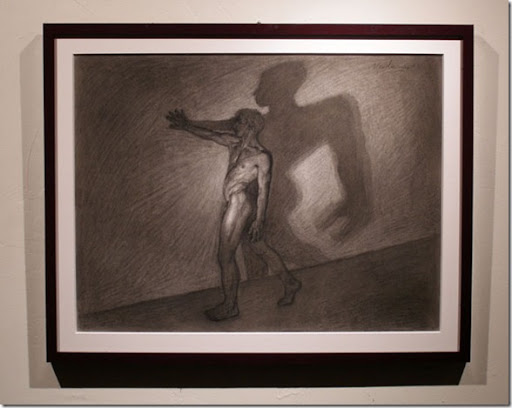
This black and white drawing shows the desire of a man to want more in his life, to break away from the shadow that haunts him. Exposed for all to see, the man in the picture yearns for freedom, away from the pressures from which he came. The dark that surrounds him seems to take over, but the small amount of light from his body provides a sense of hope. This image reminds me of the desires of Gilbert Erskine, a man who commits suicide to escape and to reach salvation. Gilbert, like the man in the picture, is weighed down by societal expectations, destined to fulfill only what the people want. At first, Gilbert conforms, marrying the first girl that seems appropriate and becoming a minister that his flock wants. However, Gilbert becomes unsettled with his life choices, maybe not wanting more from life, but wanting to escape the iron clad bonds of expectation.
Gilbert's shadow, in this case, is society itself, which ultimately brings him to the brink of suicidal. In addition, sex with his newlywed seemed to jail him in the prison of sin. To obtain his freedom and forgiveness from God, his entire being must be obliterated, extinct. Ultimately, the dark and shadowy choice of suicide surrounds him, but he still remains to have a glimmer of hope for the future.
An Introduction of The Widow Bride
"The Widow-Bride, when first seen, looked nothing like a bride, still less like a widow. She was wearing a floral-print organdy shirt- waist with a flared skirt, of the kind a high school girl might wear to her graduation. Its sash was a crimson ribbon, limply tied in a boy. Its mother-of-pearl buttons were elaborately but crookedly buttoned to her throat as if she were cold. She appeared to be wearing a white glove, and carrying the other. Her hair, the hue of faded rust, had been fashioned into an inexpert French twist, and was already loosening; she'd pinned a pink rosebud to the twist, and the rosebud was drooping. Her stockings were a size or two too large for her extremely slender legs, and we baggy at the ankles. Her shoes were white patent leather with a medium heel: Sunday church shoes. Her face was sallow, and sprinkled with freckles like dirty raindrops; at times it appeared smudged, partly erased like a pastel drawing. As the hotel concierge would later recount to Clyde Colborne, proprietor of the Rainbow Grand, this strange, solitary figure moved slowly and haltingly 'like a sleepwalker' amid the hubbub of the lobby. For a while, she stood by the elevators looking anxiously at the opening doors as if waiting for someone to appear; after about twenty minutes, when the harpist took her break from playing, the red-haired woman was perceived to awaken and glance about, startled. At once she left the cafe in the center lobby, in the lounge area where guests convened, standing and seated, reading newspapers, smoking. Here, the red-haired woman was observed gazing with childlike intensity, yet a kind of blindness, at the faces of certain male guests, who were made to feel uncomfortable. Several of these men spoke to the red-haired woman, no doubt politely, but she drew quickly away, with a shake of her head as if no, now she realized, this individual wasn't anyone she knew or was seeking." (41-42)
In the first description of Ariah Erskine after her husband Gilbert's suicide, Oates depicts Ariah in a sense of child-like wonder and confusion. Oates begins the description of Ariah as looking, "...nothing like a bride still less like a widow." Opening the paragraph with an image of a newlywed who is supposed to also be a widow, but doesn't seem like either one, Oates provides the image of a false reality. Ariah doesn't seem to realize her surroundings, not believing the reality of her situation; she is a newlywed who became a widow in less than 24 hours. In addition, the fact that she uses the appearance of Ariah as neither one or the other might mirror the fact that Ariah does not know who she is as a woman or her place in life.
Her naivety is even more apparent as Oates describes her wardrobe as, "the kind a high school girl might wear." In only the first two sentences, Oates depicts Ariah as a young, lost girl. Her frazzled appearance, in addition to her school-girl person, consists of too large, baggy clothes and messy hair. Accompanied by a, "hue of faded rust...freckles like dirty raindrops... [and] smudged face," Ariah's already dysfunctional appearance becomes dirty as well. Her weathered appearance shows that not only is she lost, but she has lost something as well. Like her husband, she has fallen, but in this case, it is the fall from innocence. On her wedding night, she experiences sex for the first time, and in agreement with her husband, she had an, "appalled fashion" (24) with sex and herself. She viewed her body as a "shadow","embarrassment", and "terror"(24). This lack of self-esteem, sex, and her husband's disappearance are all causes for this, "strange, solitary figure [that] moved slowly and haltingly like a sleepwalker."
After describing her physical appearance, Oates describes Ariah's actions and behavior in the hotel lobby. Ariah would, "glance about startled... disappearing from view." She is seen as looking with a "child-like intensity, yet a kind of blindness, at the faces of a certain male guests, who were made to feel uncomfortable." Emphasizing her child-like wonder and confusion, Ariah's actions are considered abnormal to the other guests in the lobby. Almost appearing ghost-like, Ariah has looks of frail puzzlement, enhancing her characterization as a lost, hurt, and fragile young widow.
Through her appearance and behavior, one can conclude that Ariah is a suffered soul, filled with naivety and fear. Although Ariah has lost her innocence through, in her opinion, the dirty and embarrassing act of sex, she still possess some traits of child-like wonder and curiosity.
In the first description of Ariah Erskine after her husband Gilbert's suicide, Oates depicts Ariah in a sense of child-like wonder and confusion. Oates begins the description of Ariah as looking, "...nothing like a bride still less like a widow." Opening the paragraph with an image of a newlywed who is supposed to also be a widow, but doesn't seem like either one, Oates provides the image of a false reality. Ariah doesn't seem to realize her surroundings, not believing the reality of her situation; she is a newlywed who became a widow in less than 24 hours. In addition, the fact that she uses the appearance of Ariah as neither one or the other might mirror the fact that Ariah does not know who she is as a woman or her place in life.
Her naivety is even more apparent as Oates describes her wardrobe as, "the kind a high school girl might wear." In only the first two sentences, Oates depicts Ariah as a young, lost girl. Her frazzled appearance, in addition to her school-girl person, consists of too large, baggy clothes and messy hair. Accompanied by a, "hue of faded rust...freckles like dirty raindrops... [and] smudged face," Ariah's already dysfunctional appearance becomes dirty as well. Her weathered appearance shows that not only is she lost, but she has lost something as well. Like her husband, she has fallen, but in this case, it is the fall from innocence. On her wedding night, she experiences sex for the first time, and in agreement with her husband, she had an, "appalled fashion" (24) with sex and herself. She viewed her body as a "shadow","embarrassment", and "terror"(24). This lack of self-esteem, sex, and her husband's disappearance are all causes for this, "strange, solitary figure [that] moved slowly and haltingly like a sleepwalker."
After describing her physical appearance, Oates describes Ariah's actions and behavior in the hotel lobby. Ariah would, "glance about startled... disappearing from view." She is seen as looking with a "child-like intensity, yet a kind of blindness, at the faces of a certain male guests, who were made to feel uncomfortable." Emphasizing her child-like wonder and confusion, Ariah's actions are considered abnormal to the other guests in the lobby. Almost appearing ghost-like, Ariah has looks of frail puzzlement, enhancing her characterization as a lost, hurt, and fragile young widow.
Through her appearance and behavior, one can conclude that Ariah is a suffered soul, filled with naivety and fear. Although Ariah has lost her innocence through, in her opinion, the dirty and embarrassing act of sex, she still possess some traits of child-like wonder and curiosity.
Monday, November 23, 2009
Image Study I: The Power of The Falls

"Come! Here is peace. River of Thunder the Tuscaroras named it centuries ago. Falls of Thunder. The Ongiara Indians named it Hungry Water. Devouring the unwary and the sacrifices. Those who threw themselves into its seething water to be carried off to oblivion, and peace." (26)
This image of Niagra Falls and the man balancing on a thin rope reminds me of the struggle that Gilbert faces between life and death. The Falls of Thunder, Hungry Water. That is what those of the past have called it, feeding on the weaknesses of those who are losing their balance on the thin rope of life. The Falls own mesmerizing, beautiful, and enthralling capabilities, often described by Oates herself, tease the acrobats, distracting them from the balancing act of life, and ultimately causing the plummet into oblivion. Seen in this picture, the small boy, who seems to be full of wonder and amazement, is but a mere tiny object compared to the roar and the intensity of the majestic falls. The Falls seems to have a divine power over the boy, mesmerizing and tempting him, as if the boy is what could feed the Falls' greatness. In comparison to the struggle of Gilbert and his Falls, which tempt him into oblivion, it is easy to see that the power of the Falls is undeniable.
I believe that the enthrallment of the boy with the Falls mirrors the struggle between life, death, and succumbing to a greater power. Here, the boy is seen balancing on a thin piece of rope, but he seems to be drawn to the falls, as if he could lose balance at any moment. The rope that the boy is teetering on resembles the balancing act of life, and how sometimes, death seems to be the only solution. And through death, a lure of some kind, in this case the majestic Falls, tempts us into falling. Unfortunately, Gilbert Erskine took the fall, succumbing to a greater power to find salvation. I believe that the Fall's child-like wonder and beauty masks its danger, blocking out any thought of the outside world, allowing the victim to be spellbound and fall to its divine power.
"Winking flirtatious little rainbows appeared and disappeared amid the spray. Like bubbles, or butterflies. Tempting the viewer to stare in surprise, admiration; tempting the viewer to smile. Such useless beauty, amid such destruction!" (38)

"Almost, you could drift and eddy in this space mesmerized, unthinking. You could fall under the spell of the harp's long delicate stroking notes, barely discernible above the crowd noise. You could find yourself standing transfixed in one spot not know where you were, or why." (41)
This image of the Falls further creates a concrete image of the literal and figurative fall that one must take under certain life circumstances. Seeing the presence of the Falls, one is completely blown away. A person can easily block out distractions and just focus on the wonder before him. Compared to the Falls, a person is only but a small and fragile being, and extremely insignificant as the water avalanches towards a deep and dark abyss. An abyss that is taunting, eerie, and inescapable.
The Fossil-Seeker
Gilbert Erskine, also known as The Fossil Seeker by his father-in-law, commits suicide on the night of his wedding day. Throughout the chapter, "The Fossil-Seeker", Oates gives the reader an insight into a suicidal mind.
What the readers soon learn is that Gilbert sees sex as a sin. Because he acted on the sin of sex with his newlywed, Gilbert feels dirty, guilty, and unworthy of God's respect. Gilbert admits that he only married his wife Ariah to conform to expectations of a young minister. Pressured by the society in which he lived, Gilbert felt that he must join the societal institution of marriage with a "...canny, mature, responsible wife," (34), regardless of whether he loved her or not. At first, he saw Ariah with, "...sallow skin that was radiant... green-glowing eyes as emeralds... eyes uplifted as if to heaven..." (35) However, this soon changes once he sees Ariah as an object of sex; "She was ugly to him, repulsive... offensive, obscene..." (36)
Perhaps this sudden change in opinion of his wife came from the fact that he was a minister, and to him, sex was sweaty and dirty, characteristics opposite of something pure and clean. He felt as if he betrayed God himself, succumbing to acts of filth and degradation, when in fact sex is seen as a beautiful creation of life. Another reason he could have changed his opinion so rapidly is the fact that he had never loved Ariah, and here he was, taking her innocence and purity. And perhaps, in his eyes, sex should only be between two people who love each other, to increase and multiply with one who he equally respected and loved.
In his mind, the only way to free himself from this sin is to destroy himself, wishing for total extinction and obliteration. And to redeem himself in God's eyes, he must sacrifice himself, like Jesus had sacrificed himself. Gilbert even compares his suicide to an, "act of crucifixion. A man's death and not a coward's... All the world would see." (37) In addition, he accuses the gatekeeper, who tried to stop him, as the, "Devil who teased him in the guise of a gray-haired gatekeeper." (37) His classification of suicide, especially as a sacrifice to the "mesmerizing, calming" Falls and as a view of himself as an acrobat jumping off, is one of serenity, redemption and holiness, while his idea of staying on Earth and living is thought of as sin and cowardliness.
The mindset of Gilbert is obviously not stable or clear to society, but in his mind, it is. Perhaps, ultimately, Gilbert has always been upset with his life, the way he has conformed to societal expectations, never fulfilling his own dreams. He sees that his broken life, his, "broken body would spin like a deranged moon in orbit until, in His mercy, or His whimsy, God would grant the miracle of putrefaction to inflate the body with gases, floating it to the surface of the foaming gyre, and release." (39)
Perhaps this sudden change in opinion of his wife came from the fact that he was a minister, and to him, sex was sweaty and dirty, characteristics opposite of something pure and clean. He felt as if he betrayed God himself, succumbing to acts of filth and degradation, when in fact sex is seen as a beautiful creation of life. Another reason he could have changed his opinion so rapidly is the fact that he had never loved Ariah, and here he was, taking her innocence and purity. And perhaps, in his eyes, sex should only be between two people who love each other, to increase and multiply with one who he equally respected and loved.
In his mind, the only way to free himself from this sin is to destroy himself, wishing for total extinction and obliteration. And to redeem himself in God's eyes, he must sacrifice himself, like Jesus had sacrificed himself. Gilbert even compares his suicide to an, "act of crucifixion. A man's death and not a coward's... All the world would see." (37) In addition, he accuses the gatekeeper, who tried to stop him, as the, "Devil who teased him in the guise of a gray-haired gatekeeper." (37) His classification of suicide, especially as a sacrifice to the "mesmerizing, calming" Falls and as a view of himself as an acrobat jumping off, is one of serenity, redemption and holiness, while his idea of staying on Earth and living is thought of as sin and cowardliness.
The mindset of Gilbert is obviously not stable or clear to society, but in his mind, it is. Perhaps, ultimately, Gilbert has always been upset with his life, the way he has conformed to societal expectations, never fulfilling his own dreams. He sees that his broken life, his, "broken body would spin like a deranged moon in orbit until, in His mercy, or His whimsy, God would grant the miracle of putrefaction to inflate the body with gases, floating it to the surface of the foaming gyre, and release." (39)
Sunday, November 22, 2009
Initial Reaction
The first three chapters of The Falls consists of the different viewpoints of the terrible night, in which the husband of a young bride commits suicide at Niagra Falls during their honeymoon. The first viewpoint is that of the gatekeeper, who witnessed Gilbert Erskine, the young husband, jump into the falls, committing his suicide.
Starting with the gatekeeper's experience with Gilbert's suicide, Oates creates a mysterious and supernatural tone, describing the Gilbert's unknown appearance and the Falls itself. The gatekeeper's own curiosity and suspicion of the suicidal man (Gilbert) is shown in his description of the man. The gatekeeper describes the man having, "sunken, kind of glaring eyes...conservative, somber appearance... ankles [that] shone waxy-white." (4) In addition, the man was, "...lanky, lean, slightly round-shouldered like he'd been stooping over a desk all his life." (4) Oates use of dark diction, such as "sunken", "waxy-white", and "somber", provide the reader with an eerie tone, as if the man was swallowed with some kind of evil. This first description of Gilbert hooks the reader into wanting to learn more about the mysterious, suicidal man.
In addition, Oates provides the reader with a first glimpse of the Falls as a "beautiful and enthralling" place. The Falls is then compared to the "chaos of a nightmare" and a power that "roars and shakes," allowing, "every shadow and echo of every memory erased." (5) The secretive, supernatural power of the Falls only adds to the mysterious and eerie tone of the first five pages.
At the end of the chapter, the gatekeeper compares Gilbert to a school boy, showing a "bright brash" and "salute of defiance." The contrast of Gilbert as a dark man and a young school boy confuses me. Their drastic differences, one having the appearance of solemness and the other having an appearance of hope and resilience, might provide an insight into the substantially opposing mindsets of the suicidal man and the gatekeeper. I'm sure, like most suicidal people, Gilbert felt a sense of relief, happiness, and brightness for the future, leaving his dark past behind him. His relief is also seen in a "sincere farwell... allowing [him] to die when [the gatekeeper] might have saved [him]." (6) The fact that Gilbert jumps with a brightness into the Falls shows that he thinks that death will bring him salvation and peace.
Because of the dramatically dark and somber diction used so quickly, the reader feels a small fear of some sort, one of curiosity, anxiousness, and nervousness for what is to come.
Starting with the gatekeeper's experience with Gilbert's suicide, Oates creates a mysterious and supernatural tone, describing the Gilbert's unknown appearance and the Falls itself. The gatekeeper's own curiosity and suspicion of the suicidal man (Gilbert) is shown in his description of the man. The gatekeeper describes the man having, "sunken, kind of glaring eyes...conservative, somber appearance... ankles [that] shone waxy-white." (4) In addition, the man was, "...lanky, lean, slightly round-shouldered like he'd been stooping over a desk all his life." (4) Oates use of dark diction, such as "sunken", "waxy-white", and "somber", provide the reader with an eerie tone, as if the man was swallowed with some kind of evil. This first description of Gilbert hooks the reader into wanting to learn more about the mysterious, suicidal man.
In addition, Oates provides the reader with a first glimpse of the Falls as a "beautiful and enthralling" place. The Falls is then compared to the "chaos of a nightmare" and a power that "roars and shakes," allowing, "every shadow and echo of every memory erased." (5) The secretive, supernatural power of the Falls only adds to the mysterious and eerie tone of the first five pages.
At the end of the chapter, the gatekeeper compares Gilbert to a school boy, showing a "bright brash" and "salute of defiance." The contrast of Gilbert as a dark man and a young school boy confuses me. Their drastic differences, one having the appearance of solemness and the other having an appearance of hope and resilience, might provide an insight into the substantially opposing mindsets of the suicidal man and the gatekeeper. I'm sure, like most suicidal people, Gilbert felt a sense of relief, happiness, and brightness for the future, leaving his dark past behind him. His relief is also seen in a "sincere farwell... allowing [him] to die when [the gatekeeper] might have saved [him]." (6) The fact that Gilbert jumps with a brightness into the Falls shows that he thinks that death will bring him salvation and peace.
Because of the dramatically dark and somber diction used so quickly, the reader feels a small fear of some sort, one of curiosity, anxiousness, and nervousness for what is to come.
Subscribe to:
Posts (Atom)


